Most financial advisor website design leans on the same handful of pictures: a lighthouse, a rowing crew, a handshake against a skyline. Ben Schmid had looked at enough of them to name the problem in his intake form before we’d even spoken. Generational Family Partners needed a brand that made a family’s relationships the subject, with the money in the background where Ben believes it belongs.
This is how that brand and its custom Showit website came together.
Project at a glance
| Client | Ben Schmid, founder, with Helen Schmid, Generational Family Partners |
| What GFP does | A private family advisory that helps families strengthen relational, spiritual and financial capital before and after a wealth transfer |
| Scope | Brand strategy, messaging and website copy, logo and visual identity, custom Showit website, presentation template, two-page referral sheet, client report design, business cards |
| Platform | Showit |
| Live site | generationalfamilypartners.com |
About Generational Family Partners
Ben spent the early part of his career on Wall Street and left in 2017 because the work felt transactional. He now manages wealth for a small number of families, and over the years, those conversations kept drifting toward questions like “What is this money for?” and “How much is enough?”
Then he came across the statistic that reshaped his practice: roughly 70% of family wealth is lost by the second generation, and 90% by the third. The causes he kept reading about weren’t bad investments or tax mistakes. They were relational: families who had stopped talking, trusting each other, or sharing a sense of purpose.
There’s an old phrase for this pattern, “shirtsleeves to shirtsleeves in three generations.” It describes a family that builds wealth in one generation, maintains it in the second, and loses it in the third.
Generational Family Partners is Ben’s answer. In his words, it prepares the family for the wealth rather than the wealth for the family. It runs separately from his wealth management firm, and it doesn’t give financial advice.
How we met
I met Ben through his wife, Helen. I’d been working with her on the brand for her own business, Climbing to Calling, and when Ben was ready to launch GFP, she sent him my way.
Before our kickoff, I sent Ben a welcome gift, as I do for every client. One of the objects in the gift is a moonstone. It turned out he’d already been picturing three stacked stones as his logo. In some traditions, remembrance stones mark a place so that the people who come later will ask what happened there. Ben wanted families to remember who they are to each other. We had our starting point.
What financial advisor website design usually gets wrong
Financial services branding tends to reach for permanence and prestige: navy, gold, columns, nautical metaphors. That suits a firm whose product is investment performance. It sends the wrong message for a practice whose real work is a hard conversation between a father and his grown children.
Ben’s intake put it plainly. Most legacy planning comes from wealth managers and estate attorneys, feels corporate, and is pitched to parents in their seventies. GFP needed to feel just as credible to a 65-year-old business owner and to his 40-year-old daughter who will one day run it.
The process
Every project runs through The Camera Lucida Method™, my three-phase process for finding what’s worth saying about a business and giving it form.
Witness
Ben’s intake form and a kickoff call with Ben and Helen. Two details shaped everything: Ben’s single word for the brand was “harmony,” and his values list started with confidentiality and neutrality. He wouldn’t take sides; he said, “Even if Dad is paying all the bills!”
Organize
A brand strategy document covering GFP’s brand essence, positioning, emotional signature (safety, respect, hope), audience filters, and the messaging order for the website. This is where the three-capital framework became the brand’s backbone. [Image: printed strategy pages.]

Translate into Form.
The visual identity, website, and print pieces were developed through design reviews with Ben and Helen.
One review changed the positioning. Ben and Helen had been talking with a prospective client and realized the buyer was usually the next generation, not the parents. Adult children stepping into a family business felt unprepared and wanted to be closer to their parents before the handover. Ben and Helen named it “connection before succession,” and the messaging shifted to speak to both generations.
The three-capital framework
Generational Family Partners defines family wealth as three kinds of capital. Financial capital is the money, businesses and assets a family owns. Relational capital is the trust, communication and connection between family members. Spiritual capital is a family’s shared values, purpose and faith.
Ben’s view is that most planning only addresses the first. His program spends most of its time on the other two. On the website, the framework became the visual centerpiece rather than a paragraph of explanation.
The visual identity
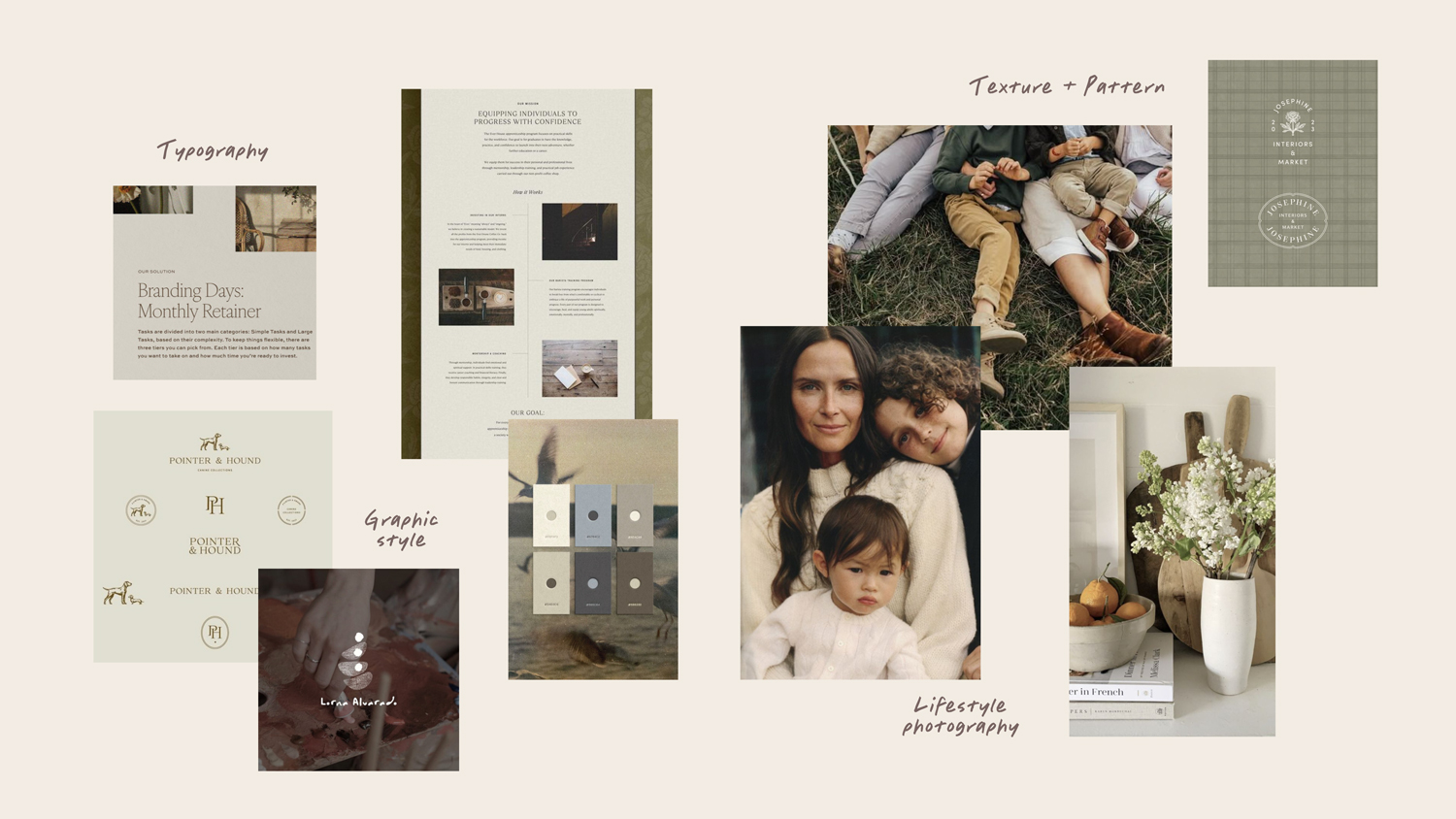
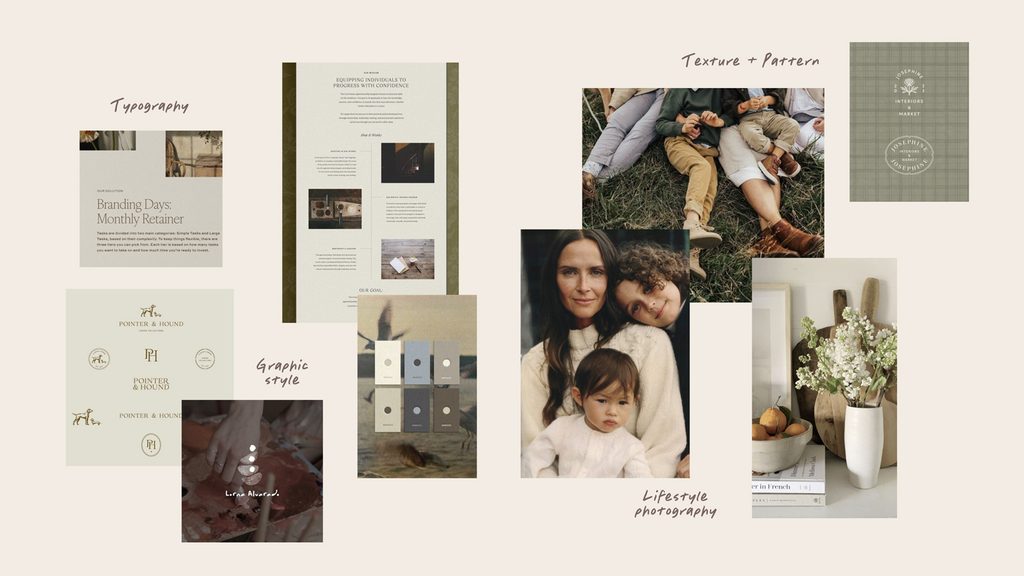
The palette is muted greens and mineral blues with warm, natural textures: linen, polished wood, smooth stone, textured paper. The photography direction calls for forest paths, garden dinners, hands, letters and heirlooms, and avoids lighthouses, boats, handshakes and skylines. In the strategy, I described the feeling we were after as “a sunlit library filled with family heirlooms.”
The logo is Ben’s three remembrance stones, one for each form of capital.
The website
The site opens with the idea that preserving wealth begins with preserving the family, then explains the three capitals before introducing the program. Ben’s work is unfamiliar to most visitors, so the order matters: by the time someone reaches the 12-month program, they already understand why it exists.

There are no testimonials and no published pricing on GFP’s site. Confidentiality is central to Ben’s work, and pricing is shared in conversation or through referral partners.
Beyond the website
Much of GFP’s business arrives by referral, often through financial advisors and other professionals. So the identity had to work on paper too:
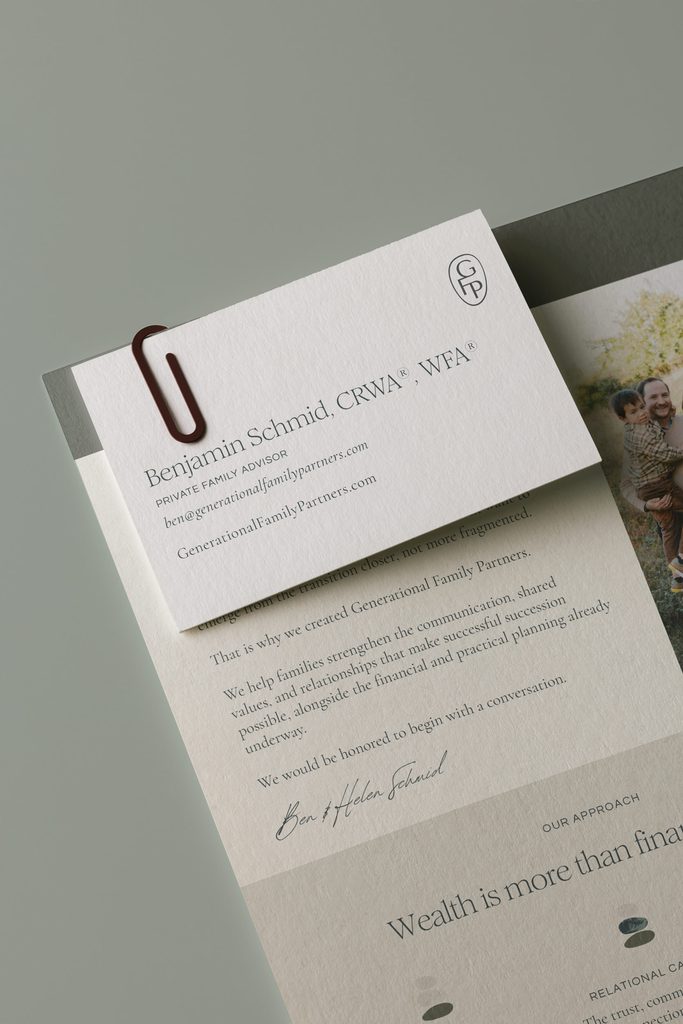
- A two-page information sheet for referral partners, opening with a personal founder’s letter
- A presentation template with stone-icon chapter dividers
- A rolling client report that grows each month, with icons for quotes, tools and reflections
- Business cards for Ben and Helen
Is this you?
This kind of project fits financial advisors, wealth managers and family-business consultants whose work has become more relational than their brand lets on. You may be adding a coaching or advisory practice beside a technical one. Your clients may come by referral and need something to hand along. Or you may simply be tired of navy and gold.
Frequently asked questions
A financial advisor’s brand usually needs to signal competence and stability. A family advisory has to signal safety and neutrality as well, because clients are bringing in relationships, not just accounts. That changes the imagery, the language and the order of the website.
It describes family wealth built in one generation and lost by the third. Generational Family Partners works on the relational causes behind that pattern.
Ben keeps client work confidential, and pricing is discussed privately. The site builds trust through a clear explanation of the framework and the program instead.
Yes. Showit gives full design control and a WordPress blog for SEO. Compliance review still happens on your side, and your site’s language should match what your regulator and firm allow.
A Signature Commission takes three to four months, from brand strategy through launch.
Working on something like this?
If your practice has grown more thoughtful than your brand shows, I’d like to hear about it. Explore the Signature Commission or begin an inquiry.